
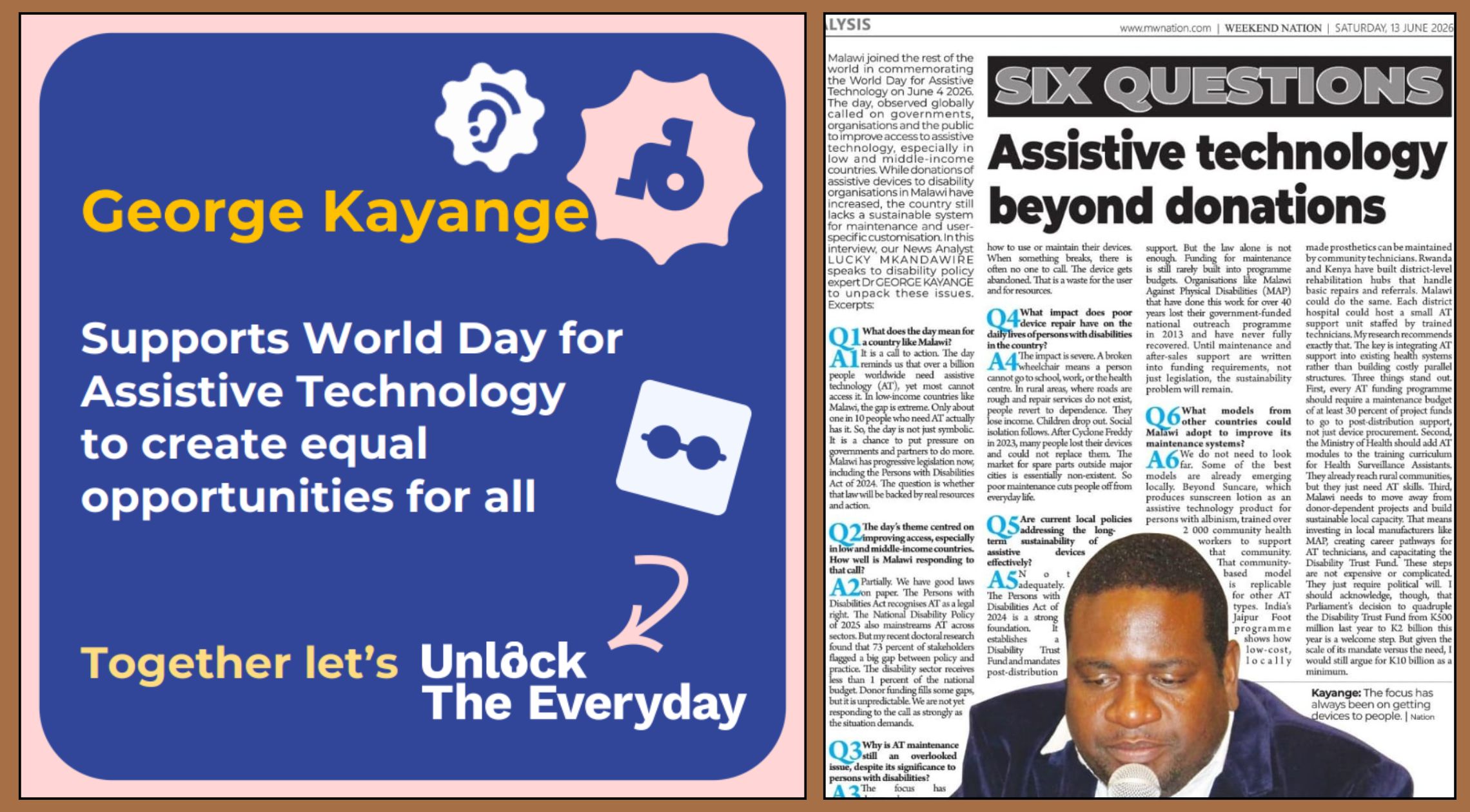
Malawi joined the rest of the world in marking World Assistive Technology Day on 4 June 2026. The day calls on governments, organisations and the public to improve access to assistive technology, especially in low- and middle-income countries. The global campaign runs under the hashtag #UnlockTheEveryday, led by ATscale, the Global Partnership for Assistive Technology, alongside UNICEF, the World Health Organization and the International Disability Alliance. In Southern Africa, the Southern Africa Federation of the Disabled (SAFOD) leads the campaign.
Journalist Lucky Mkandawire of the Weekend Nation spoke with disability policy expert Dr George Kayange. The interview ran in the newspaper’s “Six Questions” feature on Saturday, 13 June 2026, under the headline “Assistive Technology Beyond Donations.” His core message was simple. Donations alone are not enough.
A call to action, not just a celebration
Dr Kayange said the day works as a reminder, not a celebration. Over one billion people worldwide need assistive technology, yet most cannot access it. In low-income countries like Malawi, the gap runs deep. Only one in ten people who need a device actually has one.
He said the day exists to push governments and partners to do more, not simply to mark the calendar. Malawi already has strong legislation in place, including the Persons with Disabilities Act of 2024. The real question, he said, is whether that law gets backed with real money and real action.
Good laws, weak follow-through
Asked how well Malawi is responding to the day’s theme of improving access, Dr Kayange gave a mixed answer. The country has good laws on paper. The Persons with Disabilities Act recognises assistive technology as a legal right, and the National Disability Policy of 2025 builds assistive technology into systems across sectors.
But his own doctoral research found a clear gap between policy and practice. Seventy-three percent of stakeholders he surveyed flagged this gap directly. The disability sector receives less than one percent of the national budget. Donor funding fills some gaps, but it remains unpredictable. He said Malawi is not yet matching the scale of the need.
Devices without repair plans
Dr Kayange explained why maintenance gets overlooked, despite mattering so much to people’s daily lives. He said the focus has always been on getting devices to people. Maintenance comes later, and that is exactly where the system breaks down.
Donors fund procurement because it produces visible, countable results. Wheelchairs distributed make for a strong statistic. Maintaining those same wheelchairs is harder to see and far less funded. His research found that five out of six mobility device users received no training at all on how to use or care for their equipment.
The result plays out in daily life. When a device breaks, there is often no one to call. The device gets abandoned, wasting both the user’s mobility and the money spent supplying it in the first place.
What breakdown means for daily life
Dr Kayange described the impact of poor device repair as severe. A broken wheelchair stops a person going to school, to work or to the health centre. In rural areas, where roads are rough and repair services barely exist, people fall back into dependence on others.
He pointed to real consequences that follow. Income drops. Children drop out of school. Isolation sets in. After Cyclone Freddy struck in 2023, many people lost their devices entirely and could not replace them. Spare parts remain almost impossible to find outside major cities, cutting people off from everyday life.
Three problems, three solutions
Dr Kayange named current local policies as not yet adequately addressing the long-term upkeep of assistive devices. He set out three issues holding Malawi back.
- Devices get donated, but funding rarely covers ongoing maintenance.
- The disability sector receives less than one percent of the national budget.
- After-sales support is missing from most funding programmes.
He also set out practical steps that could change this picture.
- Every funding programme for assistive technology should set aside at least 30 percent of its budget for support after devices are handed out.
- The Ministry of Health should add assistive technology training to the curriculum used for Health Surveillance Assistants.
- Malawi should invest in local manufacturers, such as Malawi Against Physical Disabilities (MAP), and build clear career paths for assistive technology technicians.
Looking at models from elsewhere
Asked what models from other countries Malawi could adopt, Dr Kayange said some of the best examples are already emerging closer to home. He pointed to Beyond Suncare, which makes a sunscreen lotion designed for persons with albinism, and trains over 2,000 community health workers to support that community. He said this community-based model could work for other types of assistive technology too.
He also looked further afield. Rwanda and Kenya have built district-level rehabilitation hubs that handle basic repairs and referrals. He said Malawi could build the same system, with each district hospital hosting a small assistive technology support unit staffed by trained technicians.
India’s Jaipur Foot programme offered another lesson, showing how low-cost, locally made prosthetics can stay in working order through support from community technicians.
A meaningful step, but not enough
Dr Kayange welcomed Parliament’s decision to quadruple Malawi’s Disability Trust Fund, from K500 million last year to K2 billion this year. He called it a welcome step. Given the scale of the need, though, he argued that K10 billion would be a more realistic minimum to start with.
He closed with a clear shift in focus. Getting devices to people has always come first. The next step, he said, is keeping those devices working.
You can read the full interview in the Weekend Nation, published Saturday, 13 June 2026.
Follow the campaign on social media using #UnlockTheEveryday, #WorldATDay and #MeAndMyAT.